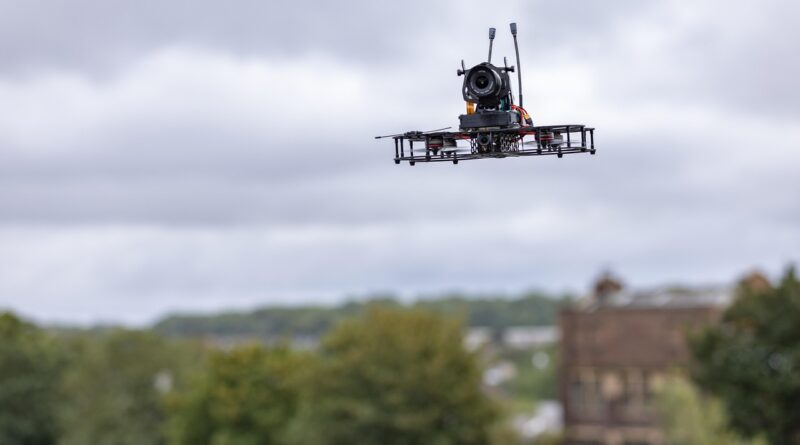
Counter-Drone Detection: Sensor Fusion and Interoperability
Integrating multiple detection technologies through open architectures to deliver more reliable, adaptable and affordable protection of critical infrastructure.
Detecting small drones around critical infrastructure increasingly requires more than a single sensor. Radio-frequency receivers, radar, acoustic arrays and optical cameras each identify different characteristics, but none provides reliable detection under all operating conditions.
Sensor fusion combines these complementary data streams into a common operational picture. RF sensors identify communication signals and potentially locate operators. Radar detects moving objects independently of their communications. Acoustic sensors recognise propulsion signatures, while electro-optical and thermal cameras provide visual confirmation.
The challenge is not simply connecting sensors. Their observations must be time-synchronised, spatially correlated and associated with the correct target. Algorithms must distinguish multiple drones, birds and background interference while managing conflicting measurements and sensor uncertainty.
Interoperability is becoming equally important. Proprietary systems can restrict operators to particular sensors, software platforms or effectors. Open architectures allow equipment from different manufacturers to exchange detection data and support incremental upgrades without replacing entire installations.
Standards and initiatives such as SAPIENT, developed through the UK’s Defence Science and Technology Laboratory, support modular sensor integration and machine-readable reporting.
Emerging developments include edge AI for local classification, distributed low-cost sensor networks and adaptive fusion algorithms that adjust to changing environmental conditions.
For smaller infrastructure operators, the opportunity lies in combining affordable commercial sensors with interoperable software rather than investing in a single expensive detection platform.
The next competitive advantage will be the ability to integrate heterogeneous sensors, maintain reliable target tracks and connect detection to appropriate countermeasures—without dependence on one manufacturer.
Key industry players include Dedrone (Axon), DroneShield, Aaronia, Sensofusion and Dronetag, alongside specialist radar, optical sensor and software integration providers.