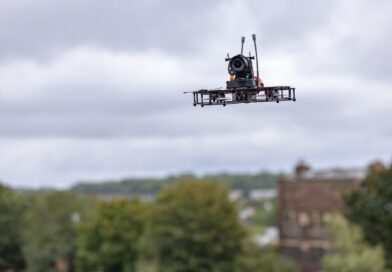
Protecting airports, ports, prisons, power stations and other critical infrastructure from hostile drones requires more than detection. The challenge is neutralising threats safely, without disrupting essential systems or creating additional risks.
Non-kinetic countermeasures are evolving beyond conventional radio-frequency (RF) jamming towards more selective, intelligent technologies.
RF jamming disrupts communication between a drone and its operator. However, autonomous drones may continue their mission despite losing connectivity, while indiscriminate jamming risks interfering with legitimate communications.
GNSS/GPS spoofing introduces misleading navigation signals, potentially causing drones to miscalculate their position or trajectory. Its effectiveness is increasingly challenged by multi-sensor navigation, inertial systems and anti-spoofing technologies.
Cyber takeover systems exploit compatible communication protocols to identify, intercept or redirect drones. Unlike broad-spectrum jamming, they can offer more targeted intervention, although encrypted and proprietary systems present significant obstacles.
High-power microwave (HPM) effectors can disrupt onboard electronics, potentially neutralising multiple drones simultaneously, including autonomous platforms. Their deployment near sensitive infrastructure raises electromagnetic compatibility and collateral-effect concerns.
Emerging developments include AI-assisted threat classification, distributed sensor networks, open counter-UAS architectures and adaptive effector selection.
Yet a fundamental technology gap remains: disabling a drone does not guarantee a safe outcome. Uncontrolled descent, hazardous payloads and unpredictable autonomous behaviour can create new threats.
The next breakthrough may therefore come not from stronger electronic countermeasures, but from integrated systems capable of identifying vulnerabilities, selecting proportionate responses and achieving predictable neutralisation with minimal collateral effects.